
Serengeti Safari in Africa: A Journey Through Tanzania’s Northern Circuit
There are few words in the travel world that stir the soul like Serengeti. To say it out loud feels like casting a spell: Se-ren-ge-ti. Even before setting foot there, you know this is a place where something bigger than yourself awaits.
A safari in the Serengeti is not a vacation. It is an awakening. It is the moment when you stop scrolling and start truly seeing. When you are surrounded by landscapes so vast, animals so wild, and skies so wide that you wonder how you’ll ever explain it back home.
And yet, the Serengeti is not just about what you see it’s about what you feel. A reminder of the raw, untamed pulse of life. A mirror that reflects your own smallness and your own humanity at the same time.
The Serengeti: A Landscape Carved by Time

Standing in the Serengeti feels like standing in eternity. The land itself seems unchanged from the days when early humans first walked upright here. Scientists tell us that some of our oldest ancestors roamed this region, and when you look across the plains, you can almost sense their footprints beneath the soil.
The Serengeti is 14,750 square kilometers of wilderness, yet it never feels repetitive. The golden grasslands stretch endlessly, but then suddenly give way to riverine forests, rolling hills, and dramatic kopje. Each ecosystem is alive with its own community of animals.
-
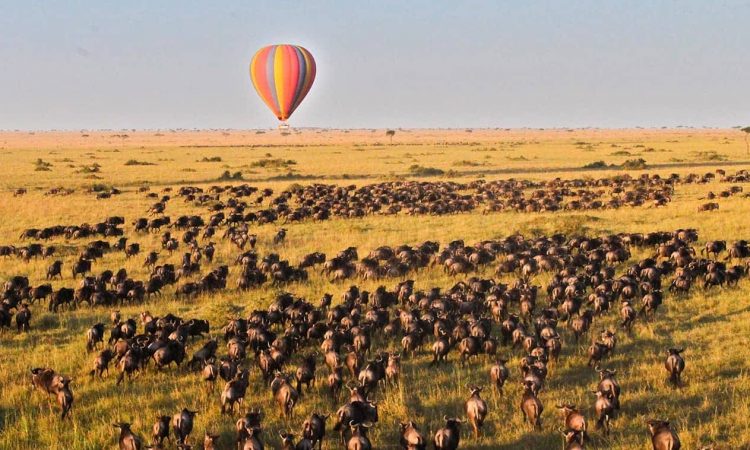
The endless plains: Home to migrating wildebeest, zebras, and gazelles, stretching so far you lose track of distance.
-
The kopjes: Granite outcrops that rise like islands, offering havens for lions, leopards, and even tiny hyraxes.
-
The rivers: Lifelines that attract everything from thirsty elephants to stealthy crocodiles.
-
The skies: Open, boundless, and constantly changing from blazing sunrise to storm clouds that roll in with theatrical power.
Unlike many destinations that feel designed for tourists, the Serengeti has no pretenses. It is what it has always been: wild, patient, eternal.
The Great Migration: Nature’s Greatest Show
The Great Migration is often called the “eighth wonder of the world,” and once you witness it, you understand why.
Each year, more than 1.5 million wildebeest, 500,000 zebras, and countless gazelles move in a never-ending circle across Tanzania and Kenya. Their journey is not guided by maps, but by instinct an ancient pull to follow the rains and the grass.
-
In the south (December–March): The plains of Ndutu transform into a nursery. Over 400,000 wildebeest calves are born in a matter of weeks. Lions and cheetahs follow closely, and each day is a test of survival. You’ll witness scenes of both tenderness mothers cleaning their newborns and ferocity as predators stalk the weak.
-
In the west (May–July): The herds encounter the Grumeti River. Crocodiles, some over 15 feet long, lie in wait. The water churns with drama, life, and death.
-
In the north (August–October): The legendary Mara River crossings unfold. Thousands of wildebeest gather at the banks, pacing, nervous, waiting for one brave soul to jump. When they do, chaos erupts animals leaping, swimming, struggling, some surviving, some not. It is heartbreaking and exhilarating all at once.
-
In November: The rains pull the herds south again, beginning the cycle anew.
To stand there, dust in your eyes, ground trembling, heart racing you realize this is not just a migration. It is a testament to the will to live, a story older than civilization itself.
Beyond the Migration: Everyday Wonders
While the migration is the Serengeti’s headline, the park offers a thousand smaller stories each day.
Picture this: a lioness teaching her cubs to stalk. They pounce, clumsy but determined, on each other’s tails. The mother watches patiently, knowing these games are lessons in survival.
Or imagine a cheetah sprinting. From stillness to full speed in seconds, chasing down a gazelle with breathtaking grace. You hold your breath, torn between admiration and empathy.
Then there are the quiet giants elephants. You’ll watch as they march in matriarch-led families, pausing to let their calves play in the mud. Their intelligence shines in their eyes.
And don’t forget the sky. More than 500 bird species make the Serengeti home. From the rainbow flash of a lilac-breasted roller to the powerful soar of an eagle, the air is as alive as the ground.
Every corner of the Serengeti whispers something new. Every game drive is a chance for the unexpected.
The Northern Safari Circuit: More Than Serengeti

The Serengeti is the crown jewel, but the Northern Circuit is the whole treasure chest.
-
Ngorongoro Crater: A vast volcanic caldera that shelters over 25,000 animals. Where else can you see lions, rhinos, flamingos, and hyenas all in one morning? Standing on the rim at sunrise, mist rising like breath from the crater floor, feels like standing at the edge of creation itself.
-
Tarangire National Park: Known as the land of elephants. In the dry season, hundreds gather by the Tarangire River, their trumpets echoing under ancient baobabs. This is also the place to see rare species like fringe-eared oryx and kudu.
-
Lake Manyara: Compact, lush, and diverse. Here, tree-climbing lions lounge in branches, flamingos turn the lake pink, and hippos wallow in pools. The forest canopy buzzes with monkeys, making it a park of delightful contrasts.
-
Arusha National Park: A hidden gem near the safari gateway city. From canoeing on Momella Lakes to spotting colobus monkeys in the trees, it’s a refreshing blend of landscapes plus stunning views of Mount Meru.
Together, these parks form a circuit that is unrivaled in Africa. Nowhere else can you find such a concentration of beauty, variety, and accessibility.
A Day on Safari: The Rhythm of the Wild
Safari life teaches you to slow down and listen.
-
Dawn: Your guide wakes you early. The world is still half-asleep, but already, hyenas are laughing in the distance. Wrapped in a blanket, you sip hot coffee as the first orange streaks light the horizon. Then the vehicle moves, and suddenly there they are. A pride of lions, still on the move after a night hunt. You whisper without meaning to. The wild demands reverence.
-
Late morning: The heat builds. Animals retreat to shade, and you do the same. Back at camp, you feast on a hearty breakfast, swap stories with fellow travelers, maybe take a dip in the pool. Time stretches. Life slows.
-
Afternoon: Back on the plains, everything has changed again. A leopard has descended from its tree. Giraffes cross the track in slow-motion elegance. The light turns golden, soft, perfect for photography. The world feels cinematic.
-
Evening: You return to camp as the sun dips. A fire is lit, drinks are poured, and the Serengeti sky erupts with stars. You’ve never seen so many, so bright. The crackle of the fire mixes with the distant roar of lions. It is at once thrilling and comforting.
This rhythm wake, watch, wonder, rest, repeat becomes addictive. It’s a rhythm many travelers ache to return to long after they’ve gone home.
Human Connection: The People of Tanzania
The safari is not only about wildlife. It’s about the people who guide you, host you, and share their land.
The Maasai, with their red shúkà cloth and beadwork, are one of the most iconic communities. They have lived alongside wildlife for centuries, their lives interwoven with the land. Visiting a Maasai village is a chance to learn not as a tourist, but as a guest about resilience, culture, and respect for nature.
Your guide, too, is often the soul of your safari. Many grew up near these parks, learning to read the land from childhood. They can spot a cheetah in tall grass before you even know where to look. But more than their skill, it’s their stories and humor that stay with you. Guests often say, “I came for the animals, but I left with a friend.”
The human connection grounds the safari. It reminds you that this isn’t just a wilderness, it's a home.
Why Choose Tanzania Safari Source Tours

Not all safaris are equal. At Tanzania Safari Source Tours, we believe your safari should be more than a trip. It should be a memory you carry forever.
-
We are Tanzanian-owned, rooted in this land. When you travel with us, you support local communities directly.
-
We specialize in both group safaris (for budget-conscious adventurers who want to share the journey) and private safaris (for those seeking exclusivity and flexibility).
-
Our itineraries include the full Northern Circuit, from Serengeti to Ngorongoro to Tarangire and beyond.
-
Our guides are handpicked not just for their expertise, but for their passion and warmth.
-
We offer accommodation options for every traveler camping under the stars, cozy lodges, or luxurious tented camps.
For us, this is not business, it's sharing our home with you.
When Is the Best Time to Visit Serengeti?
The Serengeti changes with the seasons, and each one tells a different story.
-
December – March (Calving season): Baby wildebeest everywhere, predators in action, lush green landscapes. Incredible photography.
-
April – May (The long rains): The land blooms. Fewer crowds, lower rates, and dramatic skies. Perfect for travelers who value solitude.
-
June – July (River crossings begin): Herds move north, Grumeti River crossings unfold. Cool mornings, excellent visibility.
-
August – October (Mara River drama): Peak migration crossings in the north. The most iconic safari moments happen now.
-
November (Short rains): The herds return south. Fresh grass, vibrant birdlife, and a renewed Serengeti.
Every month brings something worth witnessing. The only “bad time” is not to go at all.
Practical Tips for Your Serengeti Safari
-
Pack neutral-colored clothing khaki, beige, olive so you blend with the environment.
-
Bring layers mornings are cold, afternoons hot.
-
Binoculars make the difference between guessing and truly seeing.
-
Stay at least 4–6 days to really experience the Serengeti and Northern Circuit.
-
Trust your guide; they are storytellers, protectors, and friends.
-
Be present, don't live through your lens alone. The Serengeti deserves your eyes, not just your memory card.
Start Your Serengeti Journey Today
Some journeys you remember. Others transform you. A Serengeti safari belongs to the second kind.
This is not just about seeing lions or ticking off the Big Five. It’s about standing on the plains and realizing the world is bigger, wilder, and more beautiful than you ever imagined.
The Serengeti is waiting. Let’s write your story together.
Contact Us for the Best Choice of Your Safari